Named after Alan Freed, the original Rock and Roll DJ and dedicated mostly to music & radio. See also my Classic Film & TV blog @ http://thesilverscreenchronicles.blogspot.ca/
For My CIUT 89.5fm in Toronto radio playlists; http://moondogsplaylists.blogspot.com/
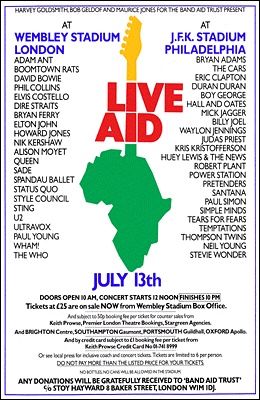
37 years ago this week on July 13 1985; Live Aid, a benefit concert for the people of Ethiopia then suffering through a terrible famine and the largest benefit concert in the world at the time, took place with two simultaneous shows in London and Philadelphia as well as being broadcast worldwide in TV. Smaller concerts were also held in the Soviet Union, Canada, Japan, Yugoslavia, Austria, Australia and West Germany and parts of these shows were also aired.
DIRE STRAITS & STING ~ "MONEY FOR NOTHING";
Best known now (musically at least) for sets by Queen (that kicked off their comeback), a Black Sabbath reunion with Ozzy, a Led Zeppelin reunion (with Phill Collins), a Who reunion, Dire Straits (with Sting) and U2. The sets by U2, Dire Straits and Simple Minds helped make them major stadium stars, although in the case of Simple Minds it would not last. In checking out the line-up I see there were several last minute additions not on the poster including Black Sabbath (with Ozzy), Tom Petty, Madonna, The Hooters, Tina Turner, Paul McCartney, Cliff Richard, Four Tops, RUN DMC, George Thorogood w/Bo Diddly & Albert Collins, BB King (via satellite from Holland) Prince (ditto), Loudness (from Tokyo), Autograph (from Russia), Kool & The Gang (from a studio), Pat Metheny, CSNY, The Beach Boys, Joan Baez, Teddy Pendergrast (in his first appearance aftr being paralyzed in a car accident) and Dylan with Keith Richards & Ron Wood closing the show. Most acts did from one to three songs bout a few got slightly longer sets. Phill Collins actually played both shows as he palyed London then hopped on the Concorde and flew to America to play with Zeppelin. As I recall the set with Dylan, Keith Richard and Ron Wood was a complete trainwreck as was the Zeppelin set as it was obvious none of them had bothered to rehearse.
U2 ~ "SUNDAY BLOODY SUNDAY";
The concert was a by-product of the "Do They Know It's Christmas" single the previous year arranged by Bob Geldoff and Midge Ure and the following singles in America ("We Are The World") and Canada "Tears Are No Enough"). I was too young to have actually seen any of these bands but as a New Wave kid watching on TV I was primarily there for U2, Simple Minds, Pretenders, Ultravox and Adam Ant in that order.
SIMPLE MINDS ~ "DON'T YOU FORGET ABOUT ME";
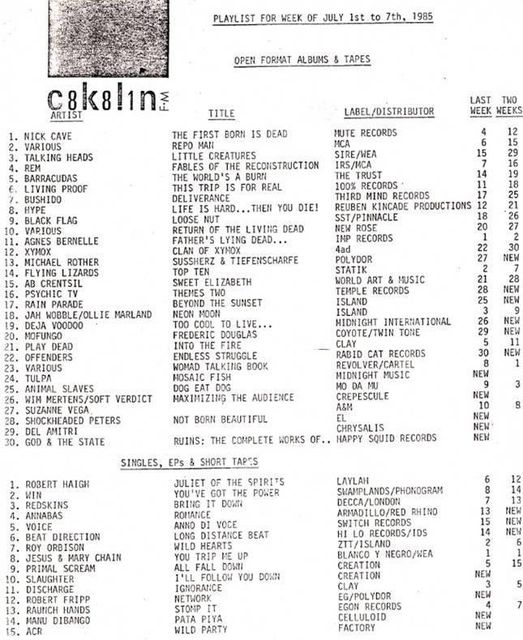
In Toronto one oddity was that the only radio station that simulcast the entire concert was the tiny campus station CKLN (rival CIUT did not go on air until the next year) using their cable feed. CKLN had been on air since 1981 and was by this point known as a station which played underground and avant garde music and most of the bill was totally mainstream but among the New Wave acts who had been on the CKLN/campus charts only a few years earlier; U2, Simple Minds, the Pretenders, Ultravox, the Boomtown Rats, Tom Petty, Elvis Costello, Style Council, Adam Ant, Sting (in the Police), the Cars, Alison Moyet (in Yazoo), Paul Young (in the Q-Tips), Tears For Fears (including as the Graduates), Run DMC and Judas Priest plus Bowie, Bryan Ferry, Paul Simon's "Graceland" & Neil Young's "Trans" albums. Although by 1985 some of these acts certainly still got some airplay on CKLN along with other campus stations that were less aggressively avant garde than CKLN.
THE PRETENDERS ~ "MIDDLE OF THE ROAD";
By contrast here are the actual CKLN Charts for July/85; The Jesus & Mary Chain (and it's early wall-of-feedback era too, Hell Yeah!), Nick Cave, Black Flag, the Barracudas, Deja Voodoo, REM, Talking Heads (their last decent album), Discharge, Robert Fripp, Jah Wobble, Psychic TV, Rain Parade, Primal Scream, A Certain Ratio, Del Amitri, the Redskins (best name for a Marxist Mod band ever), Slaughter (the Toronto Thrash band not the later US Hair Metal band), Living Proof, Suzanne Vega, Roy Orbison's comeback album and the soundtracks for "Repo Man" & "Return Of The Living Dead". About the only bands here that could have possibly been asked to play Live Aid would have been Talking Heads if they had not essentially stopped touring by that point and maybe Robert Fripp with King Crimson who also were not touring. I could possibly see Suzanne Vega doing "Luka" in a studio via satellite. REM had not yet made the jump to stadium status by that point. Mind you it would have been cool if early Jesus & Mary Chain and Deja Voodoo had played. And by cool I mean a glorious clusterfuck of historic proportions. I don't think the TV audience was ready for that.
Well, We're all in quarentine now and haven't seen a live gig since St Patty's Day, even CIUT is in lockdown but it's not like I'm going stir crazy and compliling a list of vaguely Covid related tunes or any thing. But since you asked here's a list of vaguely Covid related tunes for your dancing-at-home-like-Risky-Business pleasure;
HUEY PIANO SMITH & THE CLOWNS ~ "THE ROCKING PNEUMONIA & THE BOOGIE WOOGIE FLU";
The orginal version of a song that would be better known as an Aerosmith.
LITTLE WILLIE JOHN ~ "FEVER";
The original and still the best version of this classic.
THE BEACH BOYS ~ "IN MY ROOM";
If there was anybody who probably would have enjoyed quarentine it was Brain Wilson.
THE McCOYS ~ "FEVER"
Still the best cover of this song.
AEROSMITH ~ "THE ROCKING PNEUMONIA & THE BOOGIE WOOGIE FLU";
Pretty sure Aerosmith are immune to any virus known to man at this point.
ROBERT PALMER ~ "DOCTOR DOCTOR";
Robert Palmer was like the frat-boy version of Brian Ferry which seems like a dumb idea but it works here.
ROXY MUSIC ~ "LOVE IS THE DRUG";
By this point Bryan Ferry was the lounge lizard version of early Bryan Ferry but it totally works
X-RAY SPECS ~ "GERM FREE ADOLESCENTS";
X-Ray Specs only ballad and it's as perfect as you could ask for.
JOY DIVISION ~ "ISOLATION";
Joy Division should be the official band of any quarantine
ECHO & THE BUNNYMEN ~ "MY LIFE'S THE DISEASE";
And Echo & The Bunnymen can open for Joy Divison
SIOUXSIE & THE BANSHEES ~ "PLACEBO EFFECT";
No; Echo & THe Bunnymen can open for Siouxsie & the Banshees, who can then open for Joy Division.
SIOUXSIE & THE BANSHEES ~ "PLACEBO EFFECT";
A decade later the Banshees went bac and redid the song with a freaking string section and it totally worked.
SIMPLE MINDS ~ "NO CURE";
People forget how different Simple Minds sounded when they started out.
THE FIXX ~ "SHUTTERED ROOM";
And the Fixx can open for Simple Minds
MAGAZINE ~ "THE LIGHT POURS OUT OF ME";
"Time drags, My time crawls. Like an insect, up and down the walls"
WIRE ~ "I AM THE FLY";
"I shake you down to say please as you accept the next dose of disease".
MISFITS ~ "COUGH/COOL";
Glen Danzig in his early Jim Morrison phase
IGGY & THE STOOGES ~ "SICK OF YOU";
Iggy Pop in his Jim Morrison phase.
SOCIAL DISTORTION ~ "SICK BOY";
Because of course.
MUDHONEY ~ "TOUCH ME I'M SICK";
Becuase of course pt.2
SOCIAL STRIFE ~ "COVID-19";
Local Toronto band joins in with a decent effort
DIAMANDA GALAS ~ "THIS IS THE LAW OF THE PLAGUE";
She has an entire album with a plague theme that was actually about the AIDS pandemic but it's still relevant, not to mention scary.
VAN MORRISON ~ "TB SHEETS);
Van The Man once did a classic tuberculosis song. Then he went and ruined it by becoming a conspiracy theorist mask-hole.
VICTORIA SPIVEY ~ "TB BLUES";
The original tuberculosis blues. Jimmy Rodgers would later take the title and have a bigger hit with a different TB song.
The early to mid eighties brought a brief but powerful genre of post-punk guitar rock; Celt Rockers, guitar based bands with ringing guitars, rousing vocals and martial drums, all drenched in echo all playing soaring anthems that sounded like calls to battle. Bands like U2 (Ireland), Big Country (Scotland), The Alarm (Wales), the rootsier Waterboys (Scotland), and briefly Simple Minds (Scotland) were the leaders of this clan. Although these bands had roots in the same post-punk scene as the likes of Joy Division, Siouxsie & the Banshees, Gang Of Four, Magazine, Ultravox, Wire, Psychedelic Furs, the Cure, Cult and Echo & The Bunnymen. The Celts had a distinctive approach, the English post-punks, while certainly capable of playing rousing calls to action (especially Gang Of Four) for the most part cultivated an image of dour, moody, introspection and lyrical obscurity. Their music belonged in dark underground clubs and occasionally cavernous dance halls or for sitting at home scanning the covers and liner notes for hidden meanings. The Celt bands on-the-other-hand sounded like they belonged in misty hills and glens gathering the clans for combat. Instead of English reserve and faux-profundity their lyrics invoked dreamy mystical imagery with more overt left-wing nationalistic political calls to action.
U2 ~ "I WILL FOLLOW";
There were already punk and post-punk bands from the Celtic fringe era of course but they fit into existing genres of Punk (Undertones, Stiff Little Fingers, Exploited, Outsiders), Post-Punk (Midge Ure of Ultravox and Visage, John McGeogh of Magazine, The Banshees and Visage, The Boomtown Rats, Simple Minds), Pop Punk (The Jolt, The Revillos) New Wave (the Cuban Heels, Altered Images, Orange Juice), Proto-Industrial (Robert Rental), Rockabilly (Shakin' Pyramids) or Pub Rock (Billy Bremner of Rockpile and the Knopfler Bros of Dire Straits) plus proto-punks Thin Lizzy if they count. But these bands were not notably different from Anglo bands. There was nothing particularly Celtic about them aside from a few Irish folk music refrences from Thin Lizzy.
SIMPLE MINDS ~ "I TRAVEL";
The most iconic and successful of these bands was of course U2 whose first three albums ("Boy" (1980), "October" (1981), "War" (1983) and the 1984 live "Under A Blood Red Sky") basically codified the sound with Big Country following up with three albums starting with "The Crossing" (1983), "Wonderland" (1984) and "Steeltown" (1985) and the Alarm with an ep in 1983 and the "Declaration" (1984) album. All these albums differed from the English post punk guitar bands in another significant way; they were actually hits in the USA. The Anglo bands were often critical darlings and earned cult followings in a few big cities in the American North East and a few college towns and Canada but the response from the heartland and commercial radio was underwhelming. All that mopey English reserve and arch artiness along with guys in eyeliner and severe haircuts left the heartland cold, but U2 and Big Country had a populist streak and their rousing epic sound were perfect for the stadiums of the mid-west industrial towns in a way that even Joy Division, for all their brilliance, could never be. To say nothing of the harsh, dour Marxist dialectics of Gang Of Four, New Model Army or Easterhouse, the only Anglo bands who actually could, and occasionally did, record a rousing anthem.
U2 ~ "NEW YEARS DAY";
Actually this whole genre did not start with U2's 1980 album "Boy" but with a band that has been largely forgotten outside their native Scotland; The Skids. Headed by singer/lyricist Richard Jobson and guitarist Stuart Adamson and starting in with their 1978 first ep and 79 album, "Scared To Dance" and the iconic singles "Into The Valley" and "The Saints Are Coming" all the essentials are there. Loud, ringing guitars, rousing battle cry vocals and war drums in a joyous headlong gathering of the clans. The cornerstones of everything the eighties U2, Big Country and Alarm would be are clearly on deck. As a singer Richard Jobson was an acquired taste, with his tuneless, wobbly, bellow making Sham 69's Jimmy Pursey sound like Brian Ferry but Stuart Adamson's guitar clearly previewing his later work in Big Country albeit without the one piece missing; the echo-drenched production that Steve Lillywhite would bring to U2 and Big Country. More on him later. The Skids anthemic Celt Rock would be cited as an influence by both U2 (who would cover Skids songs in their early days and occasionally afterwards) and The Alarm while Tenpole Tudor's "Swords Of 1000 Men" would basically sound like a drunken version of the Skids.
THE SKIDS ~ "THE SAINTS ARE COMING";
The Skids would have a couple hits and get attention from critics in the UK (but not elsewhere) but their biggest impact would be in the Celtic fringe of Scotland, Ireland and Wales where they offered a stadium ready escapist alternative to Anglo gloom and doom, and one rooted in Celtic culture. The Skids themselves would not survive long enough to make good on their promise however. They were already a chronically unstable band (each album has a different rhythm section) but the bigger problem was Jobson. Besides being a terrible singer he was also a dilettante with ambitions of being a poet, play-write and actor, in the early days he did however have enough boisterous energy to spare. For the 1979 second album "Days In Europa" his lyrics are becoming denser and more pretentious although there were enough anthems like "Working For The Yankee Dollar" to make it work. The album cover also got some flack for using the same sort of Nazi poster Joy Division used on their 1978 ep. Neither band were in any way Nazis but flirting with Nazi imagery was briefly fashionable in the punk and post-punk scene until they realized they were attracting the wrong sort of attention. The Skids later switched the cover art with a more Wiemar Republic influenced one, something that other bands would also do, notably Ultravox and Visage. By the 1980 third album "The Absolute Game" the Skids had clearly lost their way. Jobson was spending more time branching out into poetry and acting and the album is a dreary pretentious mess. After that Stuart Adamson left and that really should have the end of things but Jobson carried on with the Skids as essentially a backup group to his artsy posturings for a year or so before the inevitable pretentious solo album backed with Scottish guitarist John McGeogh, fresh from English post punkers Magazine and Visage, and English pianist/singer Virginia Astley for an album of dreamy Celtic mysticism that would presage ethereal Scottish dream pop band the Cocteau Twins, and traditional Irish bands Clannad and Enya who would do it much better.
THE SKIDS ~ "INTO THE VALLEY";
Another early influential Scottish Post-Punk guitar band were Josef K starting in 1979 whose dark, angular, jittery music had much in common with artsy Anglo-Post punks Joy Division, Wire, Subway Sect, Desperate Bicycles and the Fall albeit somewhat more upbeat and dance-able. They would only record a string of singles which had some middling chart success and one 1981 album before breaking up. Although their short career did not get a lot of attention they were an obvious influence on some later bands including Bauhaus, Gang Of Four, The Smiths and especially Franz Ferdinand.
JOSEF K ~ "SORRY FOR LAUGHING";
A more hard to place Scottish band were Fingerprintz who were one of the great lost bands of the post-punk era, a talented, eccentric band led by singer Jimmy O'Neil who got uniformly enthusiastic reviews over the course of three solid but very different albums that were too hard to classify. The first album "The Very Dab" was full of dark quirky guitar art-pop somewhat similar to XTC that showed much promise while the second was more polished but still did not managed to score a real hit. The third album "Bete Noir" was a complete change in direction, a slickly dark dance album with funky basslines and even horns similar to Visage's second album. But while songs like "Catwalk" and "Beat Escape" got some play from dance club DJ's play it had little appeal for rock fans and the album's only middling sales cost them their record deal and the band then broke up.
FINGERPRINTZ ~ "WET JOB";
As fate would have it just as the musical Skids were hitting the metaphorical skids U2 were taking their template to the obvious next level with their 1980 debut "Boy" produced by English producer Steve Lillywhite who would provide the distinctive ringing echo-drenched guitar with soaring vocals that would become the signature sound for U2 and Big Country. That he got the gig at all was due to the death of Ian Curtis. By 1980 U2 had recorded two singles in Ireland that got enough attention to get them signed to a UK label and a deal to record with Joy Division's producer Martin Hannett. The first two singles were in the same basic neighbourhood as other literate guitar based post-punk like Magazine, and the Skids. The Hannett produced single "11 O'Clock Tic Toc" b/w "Touch" cleaned up their sound and set them in a direction best described as "Happy Joy Division". How the planned debut album would have sounded with Hannett at the helm is one of the great unanswered questions of the Post-Punk era. But then Ian Curtis hanged himself and Hannett dropped his existing projects to guide the surviving members (as New Order) through a new album. The two most promising of these projects were an English band, The Psychedelic Furs (who had also already recorded a single with Hannett) and U2. Ironically both bands then turned to (or were assigned to) the same producer; Steve Lillywhite.
U2 ~ "GLORIA";
Steve Lillywhite had made a bit of name producing producing an impressive array of good albums; Peter Gabriel's second album (the one with "Games Without Frontiers" "I Don't Remember" and "Biko"), Siouxsie & Banshee's debut, the first two albums from Ultravox (then led by John Foxx), the third and fourth albums by XTC and the second album from Penetration. These albums, while not sounding the same, did have similar features; loud ringing guitars, vocals clear and out front, staccato drums, clean separation of all the instruments and echo, lots of echo. This turned out to be the missing piece for for U2 giving them the perfect pallet for their canvas of epic guitar rock through the next three albums. The rest of the U2 story is too well-known to dwell on here but one by-product of their surprising success was getting the attention of Stuart Adamson then free of the Skid's sinking ship. Adamson had formed a new band named Big Country, going the Skids (and U2) one better by having not one but two ringing guitars, bassist Tony Butler fresh from recording the Pretenders brilliant single "Back On The Chain Gang" b/w "My City Was Gone" and ace drummer Mark Brezezcki who would also play on the Cult's classic "Love" album. The main feature however was Stuart Adamson's guitar; everybody took note of the wailing bagpipe sound but the Scottish influences went deeper than mere production tricks. Adamson's playing incorporated bagpipe melodies and and fiddle reels and Brezezcki's drums worked in pipeband drum rolls on songs like "Fields Of Fire" and "Close Action" and the big hit "In A Big Country".
BIG COUNTRY ~ "IN A BIG COUNTRY";
The resulting debut album "The Crossing" scored an immediate cross Atlanic hit with "In A Big Country" and sent record labels searching for the next in what now appeared to be an actual genre of Celtic guitar bands. Up popped Welsh band the Alarm. They had been playing around the punk scene with their quirk being using acoustic guitars (albeit amplified) with their rousing Clash and Sham 69 anthems and wearing a combination of American cowboy and Civil War outfits with giant exploding thatches of hair. Their 1983 debut album and album "Declaration" (neither produced by Lillywhite this time) did not get the same kind of critical hosannas as U2 and Big Country with most critics finding them promising but somewhat derivative. Still it got success on both sides of the ocean with songs "68 Guns", "The Stand" and "Where Were You Hiding". The 1985 followup "Strength" carried on in a similar vein albeit with less success.
THE ALARM ~ "WHERE WERE YOU HIDING WHEN THE STORM BROKE";
Another Scottish figure would also take a while to figure out his sound was Mike Scott who started out as early as 1978 in the wake of the Skids with a similar Another Pretty Face wich included some big guitar anthems like "Whatever Happened To The West" and "All The Boys Love Carrie" along with some more pretentious piano driven ballads. They scored some early success in the UK and toured the USA before falling apart by 1981.
ANOTHER PRETTY FACE ~ "WHATEVER HAPPENED TO THE WEST";
When Scott reemerged a couple years later with a new band the Waterboys with a ever-changing cast. Their sound was both more authentically folkrock and soulful then the other bands, mixing in some organ and horns while still having some stadium bombast with songs like "The Whole Of The Sea" and "Don't Bang The Drum" making them a more like a post-punk Van Morrison. They would also give this whole genre of Celt Rock a name which they dubbed "The Big Sound" even though they didn't really have the same dose of loud guitar anthems any more. The Waterboys would end up scoring more success than Another Pretty Face in America and especially Canada.
THE WATERBOYS ~ "THE WHOLE OF THE MOON";
A band that would score the biggest (and frankly surprising) success with a fusion of Celtic Folk Rock were Dexy's Midnight Runners, a Birmingham based band led by Irish born Kevin Rowland. He had started out with the Killjoys, a typical Pop Punk band who scored a minor hit in 1978. By 1979 Rowland had broken up the Killjoys and formed a new band as Dexys which would reject punk entirely in favour of 1960's inspired Soul Rock with a horn section. They scored some more success with their first album "Searching For The Lost Soul Rebels" and touring with similar sounding and looking Ska bands like The Specials and The English Beat. However the band was unstable and rebelled against Rowland's autocratic rule and broke up. Rowland would start over again with another lineup which got dropped from thier label and broke up yet again. When the ever stubborn Rowland reformed the band yet again it was in a very differnt form as he leaned into his Irish roots channelling Van Morrison for a Celtic Soul sound adding in traditional instruments like fiddles, accordians and banjos along with Irish vagabond clothes finally scoring a shockingly massive hit with "Come On Irene" in 1982. The song was a huge hit making the number one spot on both sides of the Atlantic the next year and is still a classic example of Celtic Folk Rock, if not THE classic Celtic Folk Hit however the song could not avoid looking like a novelty especially given their raggamuffin look.
DEXY'S MIDNIGHT RUNNERS ~ "COME ON IRENE";
Rowland found himself resentful of the hit and image he had created and this lineup broke up yet again and Rowland took two years and went back to the earlier Soul sound and look for the third album "Don't Stand Me Down" which dropped the folk elements in favour of longer soul ballads. The album got some good reviews but flopped commercially leading to the end of the band and Rowland's withdrawl into drug abuse and depression. Rowland has since alternated between periodic attempts at Dexys reunions (whithout original members) and the occasional odd and obscure solo albums.
Another band working an older tradition were the Bluebells who updated Folk Rock mixed with Skiffle, Britain's first wave of homegrown R&R from the 1950's the biggest star of which had been Lonnie Donegan of Glasgow. Starting in 1982 the Bluebells, led by indie journalist Bobby Bluebell and an ever shifting lineup, played an upbeat version of Folk Rock with the addition of fiddles and harmonicas scoring hits with songs like "Cath" and "Young At Heart", both of which actually made the charts twice. They only managed to record only an EP and album before breaking up in 1985.
THE BLUEBELLS ~ "CATH";
Scottish band Aztec Camera were not really part of the Big Sound having a lighter mix of folk and soul led by the seventeen year old Roddy Frame. On the first, album "High land Hard Rain" was largely acoustic but did share some of the lyrical themes of the other bands scoring a minor hit with the single "Oblivious". The second album (produced by Mark Knopfler) added more instruments to the mix and an ep brought a surprising (and surprisingly loud) cover of Van Halen's "Jump" that turned out to have a guitar solo that Eddie Van Halen might have found excessive.
AZTEC CAMERA ~ "JUMP";
Somewhat similar to early Aztec Camera were another Scottish band, Del Amitri who had a familiar mix of Folk Rock, Soul and Guitar Pop influnces starting in 1985 scoring some success in Britain and even briefly saw some minor chart action in the USA on the first album albeit mostly on the campus charts. Although they never managed to get the kind of attention most of the other bands here did they have managed to stick together with various lineups and continue to record today.
DEL AMITRI ~ "ALWAYS THE LAST TO KNOW";
While all this was going on some former stablemates of U2 were coming up with their own completely unique take on post-punk guitar rock. The Virgin Prunes had been friends with U2 from the the very beginings of both bands with guitarist Dik Evans being the older brother of U2 guitarist Dave "The Edge" Evans. In fact Dik had actually been one of the founding members of U2 before they decided they didn't need two guitars. While U2 were making their almost methodical climb to the big time the Virgin Prunes were doing the exact opposite. Starting around 1980 they made a series of eps and cassettes which even a fan would have to admit were willfully unlistenable cacophony. It was almost like they listened to the most wretchedly sprawling, pretentious, tuneless, murky, excessively over-the-top demos and obscure b-sides from PIL, Bauhaus, Wire, the Banshees and Clock DVA and said "I think we can top it". Their live show was even more excessive with the male band members heavily made-up and in drag like the most decadent Weimar/Dada cabaret act. By 1983 they were finally ready to make a proper record with the album "If I Die, I Die". Produced by Colin Newman (from Wire) who added some much needed discipline, basic song structure and crystalline production sheen. There was still plenty of droning and caterwauling but they did manage some proper guitar rock anthems like "Caucasian Walk". The Virgin Prunes were far too deeply weird to ever reach a larger audience even among Goths however and they took the next few years meandering around without bothering to record a followup.
THE VIRGIN PRUNES ~ "CAUCASIAN WALK";
Zerra One were another Irish guitar band who showed far less originality. They had been kicking around since 1982 recording a couple indie singles with little success until their 1984 debut album which fully adapted the sounds of U2 and Big Country and scored a minor UK hit with the anthem "10,000 Voices" but followups were less noticed and critics largely dismissed them as blander clones of U2 and Big Country which was a fair assessment.
ZERRA ONE ~ "10,000 VOICES";
An Irish band with a specific U2 connection were Cactus World News who got the attention of Bono who produced their first single in 1985 with "The Bridge". The debut followed the next year which got good reviews and scored three decent UK chart hits. However after spending the next few years touring their 1989 followup was turned down by their label which dropped the band who soon broke up with one of the guitarists joining the Australian band The Church.
CACTUS WORLD NEWS ~ "THE BRIDGE";
Another Scottish band would be plagued with similar bad luck with record labels and US radio but would manage a longer career. With the poorly chosen name GoodBye Mr Mackenzie, this Glasgow band scored their first hit on the indie singles charts in 1984 with "Death Of A Salesman". Blessed with a few singers and songwriters (including one Shirley Manson) and a slicker sound with keyboard washes to smooth out their echoing guitars courtesy of Big John Duncan (formerly of iconically obnoxious mohawk crested Punks the Exploited!) they would continue to score low level indie single hits as well as their first album in 1986. However they had problems with record labels and management and a name change to Angelfish but were never able to scare up any interest in America. They slogged on until 1994 when Shirley Manson left to join a new band, Garbage which would have much better luck.
GOODBYE MR MACKENZIE ~ "BLACKER THAN BLACK";
Meanwhile former Skids singer Richard Jobson had been watching his former bandmate Adamson make the big time with a sound noticably not disimilar from the Skids. After the breakup of that band Jobson had recorded a couple albums of pretentious poetry and meandering music and writing and acting a a few plays to little notice. By 1983 he formed a new band with fellow Scot John McGeogh on guitar, lately from Siouxsie & The Banshees and before that Magazine and Visage (he had also briefly replaced Stuart Adamson on one of the Skids' final lineups) along with one of the Skids ex bassists and drummer from Magazine. Called the Armoury Show they scored a mid-sized hit with "We Can Be Brave Again", a typical Skids style call-to-action that hit most of the notes of old but with noticeably less force. This issue wasn't really Jobson this time but McGeogh. His work with the Banshees had been brilliant and innovative with Smiths guitarist Johnny Marr citing him as a major influence. However his atmospheric style was not really suited to rousing battle cries. As for Jobson he predictably got bored anyway and wandered off to back to his poetry and McGeogh quit and joined PIL and that was that.
THE ARMOURY SHOW ~ "WE CAN BE BRAVE AGAIN";
Also carefully watching all this was another Scottish band who had been around longer than any of them. Simple Minds had formed out of Johnny & The Self Abusers, an earlier Rezillos type punk band in 1978 with their first album coming out in 1979. However at the time they seemed to have little in common with the Skids and U2. While Simple Minds clearly had guitar and drums they obviously took their influence from artsier bands like Roxy Music, Peter Gabriel and Ultravox with songs based not on guitar riffs but on the funky baselines from Derek Forbes (one of the best bassists of the post-punk era) around which were layered cascading keyboards and guitar arpeggios from Charlie Burchill and enigmatic stream of consciousness vocals from Jim Kerr. By their third album. "Empires & Dance" (1981) they had clearly made the style their own and they spent the next three albums perfecting it until they got to the critically acclaimed atmospheric "New Gold Dream" (1983) which made a lot of top ten lists. However they still had not been able to break into America aside from the club scene in a few cities and college towns nor could they get radio airplay. The solution was obvious, so in 1984 they brought in Steve Lillywhite to produce their next album, "Sparkle In The Rain" which took their usual intricate arrangements and driving basslines and ampped up the guitars and drums. The resulting album finally broke into US radio with songs like "Waterfront", "Catwalk" and "Speed Your Love To Me" and it brought them to the attention of director John Hughes in 1985 who would get them to record the theme for his next movie "Don't You Forget About Me" which would finally get them a bonafide US hit. By this time some critics pointed out that Simple Minds were doing a better U2 than U2 was, then working "Unforgettable Fire", more on that to come.
SIMPLE MINDS ~ "WATERFRONT";
In the mid-eighties there was also a somewhat related genre happening that incorporated the more dreamy, ethereal side of Celtic culture with dreamy albums from Scottish band the Cocteau Twins and Clannad, an Irish band of siblings and cousins who had actually been recording since the late 70's as a fairly traditional but modernized Celtic folk band who now plugged in, added some atmospheric keyboards and recorded a single with Bono and some soundtrack music. Enya, another member of the Clannad clan went solo, added more keys and scored an international hit with "Orinoco Flow".
CLANNAD WITH BONO ~ "IN A LIFETIME";
The Pogues, a more traditional Irish folk band went another way. Instead of the dreamy atmospherics of Clannad and Enya they adopted the rough & ready DIY attitude of punk in the person of drunken punk Shane McGowan who had been kicking around the London punk scene since from the start. The band's ramshackle Irish Folk-Punk scored unlikely hits starting in 1985 with traditional songs "Dirty Old Town" and "Waltzing Matilda". 1987's "If I Should Fall From Grace From God" (produced by Steve Lillywhite) brought another hit with "Fairy Tale Of New York".
THE POGUES ~ "DIRTY OLD TOWN";
The first and most beloved of the Irish punk bands of the first wave of Punk were the Undertones who scored classic hits with "Teenage Kicks", "My Perfect Cousin" and "Jimmy Jimmy" but by 1983 they had evolved into a slick pop band before breaking up. Singer Feargal Sharkey would go on to score a couple of pop hit singles. Guitarists John O'Neill and Damian O'Neill however formed the far more stadium friendly and overtly political band That Petrol Emotion in 1984 who would score their own Big Sound hit with the rousing nationalist anthem "Big Decision" in 1987. After a couple of minor followups the band lost their record deal and started to fragment.
THAT PETROL EMOTION ~ "BIG DECISION";
Scotland's Jesus & Mary Chain were of course the loudest guitar band of them all. Scrawny, drunken rugrat brothers Jim and William Reid formed the band with a couple of friends as rhythm section undeterred by their being barely competent musicians. Like most enthusiastic amateurs they started out as a ragged three chord punk band just as the likes of U2, The Skids, Simple Minds, Josef K and the Virgin Prunes had, albeit with non-punk influences from 1960's Folk Rock, Garage Punk and Girl Groups. By 1984 they had come up with a unique sound of their own; simple pop or folk rock songs utterly drenched in layer upon layer of screeching feedback, dense distortion and echo with booming drums and Jim Reid's droning vocals for a sound they dubbed the "Wall Of Noise" after Phil Spector. Their live shows set new standards of shambolic chaos with short sets, out of tune guitars (not that mattered considering the sheer cacophony) and drunken band members stumbling about until the inevitable crowd riot. This version lasted for a trio of independent singles and debut album "Psychocandy" in 1985 to rave if bemused reviews. But while they generated a sensation for their louder-than-loud records, riotous shows, distinctive big-black hairdos and all-black clothes and drunken interviews they were savvy enough to realize that this image would be self-limiting and by their 1987 second album they had reworked their sound to a more conventional but still distinctive guitar based echoing drone that they would follow on and off to the present day. Making them one of the least expected survivors of this era.
THE JESUS & MARY CHAIN ~ "NEVER UNDERSTAND";
Former Fingerprintz singer Jimmy O'Neil and guitarist Cha Burnz finally returned to the fray with a new band, the Silencers with a solid 1987 album "A Letter From St Paul" which as usual got them plenty of critical raves but only middling success. It would however be enough to keep them recording albums and touring for years until Burns died of cancer in 2007.
THE SILENCERS ~ "I SEE RED";
1986/87 would turn out to be both the highwater mark for the Big Sound and the beginning of the end as it's major players changed direction or faded away. Fittingly U2 were the first to do so. Just as Simple Minds had been eager to reach U2's stadium audience U2 were even more desperate to have something post-punk bands like Simple Minds, Joy Division, Japan, Magazine and John Foxx era Ultravox had long achieved; serious artistic credibility. U2 had always gotten good reviews but were seen as a good guitar rock band, but not serious, thoughtful artistes, and that is what they most wanted to be. This would require a change in direction as thorough as Simple Minds was in the process of doing, so just as Simple Minds were enlisting Steve Lillywhite to produce "Sparkle In The Rain", U2 were replacing him with none other than Brian Eno, ex of Roxy Music, the main influence of Simple Minds, Ultravox and Japan. The resulting 1985 album "The Unforgettable Fire" had a few songs that fit into their usual stadium ready repertoire but was mostly moody atmospherics that left critics and fans divided. As we all know 1987's more stadium friendly "Joshua Tree" and "Rattle & Hum" made them the biggest band in the world but it also made them and the whole genre terribly unhip, especially the film that went along with "Rattle & Hum" which allowed the band to give vent to their most cloying self-importance. Since then they have of course become the biggest band in the world in the 1990's and 2000's although nobody thinks they are cool or cutting edge anymore.
U2 ~ "IN THE NAME OF LOVE";
Too much success would create more problems for Simple Minds. "Don't You Forget About Me" was a massive US radio hit that left them with the problem of how to follow it up. They too decided to dispense with Steve Lillywhite's dense production in favour of American top-forty producers Jimmy Iovine and Bob Clearmountain for the 1987 album "Once Upon A Time". Bassist Derek Forbes, an important part of their sound was also forced out. The album which would finally give them the serious US hit they had been working towards. But even more than U2 it also appalled their longtime fans and was widely condemned as a sell-out. Songs like "Alive & Kicking", "Oh Jungleland" and "Sanctify Yourself" got plenty of airtime but they sounded more like an artsier late eighties Genesis or Cutting Crew than anything resembling Simple Minds, or even U2 for that matter. They spent the next couple of years on the road trying to figure their next move, facing more lineup changes and killing time with a live album which tellingly consisted almost entirely of songs from the last two albums. When they finally went in the studio with 1989's "Street Fighting Years" the results were not reassuring. The strongest song; the epic "Belfast Child" showed a band formerly known for obscure lyics embracing both an overtly political stance (to be fair they had also been supporting causes like Live Aid and Anti-Apartheid) and expressly Celtic folk-rock sound. Strong as it was it sounded nothing like Simple Minds. Another track to get airplay was a solid but perfunctory version of Peter Gabriel's "Biko" which they had been playing live and further showed their political awareness but also their lack of musical ideas, especially for a band whose only previous cover song had been a typically note-perfect version of Lou Reed's "Street Hassle" on "Sparkle In The Rain". Although the album topped the UK charts that was pretty much the end of their time as relevant figures in the USA. Long recording delays, record label hassles and lineup changes along with changing musical tastes in the 90's left them behind. The 1995 album "Good News From The Next World" might have been a tolerable followup to "Street Fighting Years" if it had only been released several years earlier, but by 1995 it was dangerously out-of-touch and saw little chart or radio action in the USA. The next album wasn't even released in the USA and the one after that wasn't released at all. They would continue to record and tour in the UK, indeed they still do, and they maintain a loyal following in Scotland but it speaks volumes about their status that the most notable of their sporadic releases in the last twenty years have been an album of cover songs, a surprisingly good album of acoustic covers of their older songs and a series of box sets of their glory years.
SIMPLE MINDS & SINEAD O'CONNOR ~ "BELFAST CHILD";
Big Country would have a similar but more tragic decline. In a way the success of "The Crossing" was a curse. "Steeltown" album was a worthy followup artistically, but it's more overtly political subject matter and downbeat songs left Americans cold and it lacked an obvious hit single and it saw only middling chart action. If "The Crossing" hadn't have been so huge it wouldn't have mattered but label expectations (and possibly the band as well) were bound to be disappointed. So for the next album Big Country followed the lead of Simple Minds and ditched producer Steve Lillywhite in favour of Sade producer Robin Millar who gave them a less dense, more radio friendly sound for "The Seer". The resulting album was not as drastic a change to their basic sound as Simple Minds had done with "Once Upon A Time" but it also wasn't as successful either and effectively blunted their momentum, something subsequent albums did nothing to fix. Like Simple Minds they continued to record and tour through the nineties (including the obligatory cover album) until Stuart Adamson quit to start an abortive solo project. That floundered due to his increased mental and emotional breakdown which led to his packing up and moving to Hawaii. One day in 2001 his bandmates discovered he had disappeared without warning and desperately posted a notice on their website asking for fans to find him or for him to make contact. He never did. His body was found, a suicide. More lately Big Country has reformed with guitarist Chris Watson and drummer Mark Brezezcki with Alarm singer Mike Peters filling in for Adamson.
BIG COUNTRY ~ "STEELTOWN";
The Alarm also had trouble following up their debut album "Declaration". 1985's "Strength" was largely seen as mediocre so for their third album followed the usual pattern of changing producers and recording a more commercial sounding album with 1987's "Eye Of The Hurricane" which did score a hit with "Rain In The Summertime" but their new sound was a complete break with their previous albums being light and poppy with the addition of keyboards making them sound more like Belinda Carlisle. This effectively killed whatever underground credibility they once had. 1989's "Change" which scored another hit in "Sold Me Down The River" reverted to a more folk rock sound and including a version of the album recorded in Welsh. After another album, 1991's "Raw" was less successful and led band then broke-up after Peters quit onstage although there have been periodic reunions when Peters isn't filling in for Big Country.
THE ALARM ~ "RAIN IN THE SUMMERTIME";
Yet another Irish band to get U2's patronage would be Hothouse Flowers, a Dublin band whose dense mix of Irish soul and folk was closer to Dexy's Midnight Runners, the Waterboys and mid-period Aztec Camera than the stadium-ready guitars of U2 and Big Country. Their 1988 debut album was an immediate hit on both sides of the Atlantic and Australia. However subsequent albums failed to have much success in America as tastes changed at the end of the 80's and their clean and over produced sound seemed passe. Besides collaborations with the Indigo Girls and a bizarre one with Def Leppard the next few years were spent on the road until the burned out band called a hiatus in 1994 which became essentially permanent.
HOTHOUSE FLOWERS ~ "DON'T GO";
As Celt Rock was petering out there would be one more spectacular by-product in the arresting presence, both sonically and visually, of Sinead O'Connor whose 1987 debut caused a sensation with songs like "Mandinka" and "Put Your Hands On Me" but while she had been given early support from U2 and Irish folk rock band In Tou Nua it became clear that she had little common with the Big Sound and guitar bands in general and she soon distanced herself from the scene.
SINEAD O'CONNOR ~ "MANDINKA";
The last notable band to come out of the Big Sound were the almost absurdly Scottish Proclaimers who shocked everybody (including no doubt themelves) by scoring a massive cross Atlantic hit with the insanely catchy "500 Miles" and then even managed to score a follow-up with "I'm On My Way". Twin brothers Criag and Charlie Reid had started off at the start of the 80's in a punk band called Black Flag (not that one) but been playing a version of Celtic Folk Rock since 1983 as a largely accoustic duo which got the attention of Kevin Rowland who helped them record a demo which got earned them a record deal by 1987. Their first album scored enough success in Britain to gain a spot on "Top Of The Pops" but it was the second album that scored their still iconic two hits. Like Dexy's however their idiosyncratic folky sound, nerdy look and impenetrable accents marked them out as one-hit-wonders and so they turned out to be. However unlike Kevin Rowland the wholesome Reid Bros did not have any drug problems or mental problems and seemed to be genuinely happy to return to Scotland where they continue to recored and tour and busy themselves supporting the Scottish National Party's campaign for independence.
THE PROCLAIMERS ~ "500 Miles";
By 1990 The Alarm, Armoury Show, That Petrol Emotion, Bluebells, Dexys and Zerra One had broken up and the Pogues were in a state of near collapse brought on by Shane McGowan's serious drinking problem which led to his being fired. They carried on for a while with replacement singers (including briefly his old friend Joe Strummer) but there was obviously not much point. The Virgin Prunes wandered back into the studio again for the 1987 album "The Moon Looked Down And Laughed", a slickly produced (by Soft Cell's Dave Ball) but sprawling and pretentious glam/goth/cabaret concept album that found few friends and the band promptly broke up on the eve of a North American tour. Singer Gavin Friday has since occasionally popped up with a couple of similarly art-damaged cabaret albums. Aztec Camera's third album "Love" was a slickly produced soul album similar to Style Council which got decent reviews but was not really suitable for touring. Singer/songwriter and only steady member Roddy Frame then moved to America where he continued in a similar low-key vein until retiring the band name in 1996. The Waterboys took an opposite approach with Mike Scott changing the lineup and moving to a more traditional Celtic Folk sound for 1988's "Fisherman's Blues" which was fairly successful and inspired a couple of similar album followups before Scott retired the name for awhile. He would later change his mind and resurrect the band who have recorded several more albums that range back and forth between the Folk Rock and Big Sound of their past none of which have made any waves outside of the UK.
THE WATERBOYS ~ "FISHERMAN'S BLUES";
By the early 90's most of the Big Sound was largely gone to be replaced by the related but less mystical Brit-Pop and U2 was experimenting with electro-dance but echoes would be heard in the Irish Cranberries and Scottish Franz Ferdinand. In 1995 producer Steve Lillywhite, who had gone back to working with U2 on their 1991 return to guitar rock "Achtung Baby" and some subsequent albums had a final entry into the genre with the debut from Irish band Engine Alley which scored hits in Ireland with their distinctive Celtic Folk Rock sound which included a fiddle along with the electric guitars. They failed to get much traction outside Ireland something a move to England and a reworking and re-release of the debut album failed to change and by 1999 they had effectively petered out.
ENGINE ALLEY ~ "SWITCH";
The last of the Big Sound band would turn out to be one of the most successful and tragic with the Cranberries who briefly dethroned U2 as the biggest Celtic band in the world starting in with their first hit with 1992's "Dreams" and followed it up with a string of hits until the end of the 90's. Their big guitar sound showed obvious influences from earlier Celt Rock bands but it was singer Dolores O'Riordan's distinctive sharp yodelling vocals, influenced by traditional Gaelic singing along with her winsome lyrics and beauty which really held people's attention until they took a hiatus at the end of the decade. A return to action in 2009 was less successful as tastes changed away from stadium guitars to processed studio Pop, Electronica, Rave, Dance and Hip Hop, even U2 were experimenting with electro rock, and their activities were sporadic until O'Riordan's shocking death drowning in the bathtub from complications from an addiction to painkillers in 2018. By that time the Celt Rock sound which had ruled the mid-eighties was largely a memory.
More from my Throwback Thursdays Retro Video Project. This week; More Simple Minds.
SIMPLE MINDS ~ "THIS FEAR OF GODS";
A song off the 1981 third album "Empires & Dance" using a 1924 abstract film "Symphonie Diagonale" by Swedish/German Dada film-maker Viking Eggeling.
SIMPLE MINDS ~ "70 CITIES AS LOVE BRINGS A FALL";
This song from "Sister Feelings Call" uses an odd silent short that features the miniaturized Denishawn Dancers circa 1910's
SIMPLE MINDS ~ "COLOURS FLY & CATHERINE WHEELS";
A track off the 1982 fifth album "New Gold Dream" using a 1912 film by Spanish film-maker (albeit working in France) Segundo De Chomon, a contemporary of George Melies whose style he built on.
SIMPLE MINDS ~ "KING IS WHITE & IN HER CROWD";
This video uses an old silent travel doc
SIMPLE MINDS ~ "CATWALK";
This track off the 1984 "Sparkle In The Rain" uses another film by Segundo De Chomon, "The Japanese Butterflies" from 1908. I also used this one for a track by The Band Of Susans.
SIMPLE MINDS ~ "SHAKE OFF THE GHOSTS";
An instrumental track off "New Gold Dream" using a 1924 by German Dada film-maker Walter Ruttmann, an associate of Viking Eggeling.
SIMPLE MINDS ~ "A BRASS BAND IN AFRICA CHIMES";
Another instrumental track, used as the b-side to the 1984 "Don't You Forget About Me" 12in single but most likely recorded earlier during the sessions for their sixth album "Sparkle In The Rain" in 1983 since they used the same producer in Steve Lillywhite. This is another film by Segundo De Chomon, "The Red Spectre" from 1907.
SIMPLE MINDS ~ "BRILLIANT THINGS";
This is a demo of an instrumental track that would later become "Book Of Brilliant Things" off of "Sparkle In The Rain" using some test footage from "The Wizard Of Oz" including actors Judy Garland, Bert Lahr, Roy Bolger, Jack Haley and Margaret Hamilton.
More from my Throwback Thursdays Retro Video Project. This week; Simple Minds.
I know everybody remembers them from "The Breakfast Club", "Don't You Forget About Me", and that terrible hit album they followed it up with, blah, blah blah. But they had actually been around for several years by that time having recorded six fine albums full of atmospheric, almost cinematic songs (including several instrumentals) that naturally lent themselves to silent film. At least I always thought so.
SIMPLE MINDS ~ "PLEASANTLY DISTURBED";
The epic closer off their 1979 first album "Life In A Day" mashed up here with a 1915 film "The Portrait", based on a Nikolai Gogol story directed by Polish director Władysław Starewicz, who would later be better known as a pioneer in stop action animation. This little known film is one of the first real horror films and was an obvious influence on the later German Expressionist films especially the classics "The Student Of Prague" and "Faust".
SIMPLE MINDS ~ "REAL TO REAL";
A song off the 1980 second album "Reel To Real Cacophony" using an odd French farce "The Magic Prisoners", which experiments with backwards projection to show some prisoners apparently falling upstairs and breaking into jail.
SIMPLE MINDS ~ "SCAR";
Another song off the second album using a using a short art film, "Tails" from 1976, by Paul Sharits. This film spliced together the faded, underdeveloped ends of other films, hence the title. I used this same film for songs by Cabaret Voltaire and Siouxsie & The Banshees but couldn't decide which version I liked better so I kept them all.
SIMPLE MINDS ~ "CACOPHONY";
An instrumental off the second album using a 1907 film "En Avant Le Musique" by Spanish director (albeit working in France) Segundo De Chomon, a contemporary of George Melies whose style he built upon.
SIMPLE MINDS ~ "VELDT";
Another instrumental off the second album using yet another Segundo De Chomon film "Les Lanatiques" from 1908.
SIMPLE MINDS ~ "FILM THEME";
Yet another instrumental from the second album, this time using some newsreel footage from Edison Studios of an gas refinery explosion from the early 1900's.
SIMPLE MINDS ~ "KANT KINO";
Another track off of "Reel To Real", this time an instrumental, using an early (1902) stop action film "The Destruction Of The Star Theatre" by Edward Armitage
SIMPLE MINDS ~ "ROOM";
Another track from "Empires & Dance" using a 1969 performance art film by Ben Vautier
I'll not begrudge Bowie fans their moment, but I can't really share it. I like some of his stuff just fine. "Heroes" is always majestic. You can't not like "Suffragette City", "Rebel Rebel", "Gene Genie", "Cat People" or "Ziggy Stardust". You have to also give kudos to the videos for "Ashes To Ashes" and "Blue Jean". Not to mention "The Hunger" and "The Man Who Fell To Earth". Also he rescued Iggy from the gutter. Bowie was also one of the few rockstars who could pull off the difficult role of taking a political stand without looking like an insufferable prat, unlike Bono say. Witness his dignified performance of "Heroes" at the Liveaid Aids benefit concert or his oh-so-elegant grilling of an MTV VJ over MTV's lack of black music videos back in the 80's. Bowie was so inherently classy he could pull that off without looking like a strident grouch (like Bob Geldoff) or a pompous twat (hello Sting).
DAVID BOWIE ~ "SPACE ODDITY";
Bowie was a very big deal for people who came of age musically in the mid -1970's which I can understand. The early 70's were a pretty bleak time. Progrock and Jazz Fusion were actually considered cutting-edge. Otherwise you could choose between burned-out hippies, drippy singer-songwriters, endless Southern Rock Boogie jams, proudly vacuous Bubble Gum Pop and Disco, lots of Disco. And everybody dressed like slobs. There were no "underground" or "alternative" scenes as we understand them. No indie labels, no zines, few clubs, fewer cool indie record stores and no campus radio.
No wonder Glam seemed like a breath of multi-coloured fresh air. Bowie wasn't the first Glam rocker; by many counts Marc Bolan got there first and his hits were catchier and less cluttered then Bowie's, and Bolan was cuter. But Bowie was more media-savvy and disciplined than Bolan was, more populist than Roxy Music and more talented than the likes of Gary Glitter, Jobriath, Sweet or Slade. Not to mention smarter. There was a reason why he was a hero to many of the first generation of Punks.
DAVID BOWIE ~ "ASHES TO ASHES";
Bowie was an even bigger deal for the LGTB communities which I also get. I certainly can't deny them a figure who embraced a despised group before it was fashionable. He was also a hero to fashionistas which I acknowledge but couldn't care less about.
However I never fell into any of those groups. I came of age musically in the mid 1980's "Let's Dance" era when Bowie was not only totally mainstream but completely omnipresent. In 1980's Toronto there were only a limited number of radio choices; for AM Top 40 there was CHUM and CFTR. On FM there was mainstream CHUM FM, the Classic Rockist Q-107, New Wavish CFNY and campus radio CIUT and tiny CKLN. On TV there was Muchmusic and a few assorted shows like "The New Music", "The CHUM Countdown", "American Top 40", "Midnight Special", "Solid Gold" and that was literally it. There were also dance clubs like "Nuts & Bolts", "The Silver Crown", "Empire Club", "The Copa" and "RPM". There was no internet remember so if you wanted to listen to music aside from what you actually owned those were the only options. That may actually seem like a lot compared to a lot of other cities and it was but even for all that there was shockingly little variety. CFTR, Q-107 and the two CHUMs played pretty much the same stuff, albeit in slightly different amounts, and playlists were so predictable that certain groups were guaranteed to be played multiple times a day, usually playing the same few songs. Thus for most of the decade you could be sure of hearing The Beatles, Rolling Stones, Led Zeppelin, Queen, Rush, Who, Doors, Teenage Head, Police, AC/DC, Dire Straits, Genesis, Clash and Bowie more than a few times every single day without fail. CFNY and campus radio had a mandate of "New Music" and so had more variety but there was still some overlap with certain artists who had some credibility with the New Wave/Post Punk such as Bowie, Police, Clash, Elvis Costello, Pretenders, Blondie, U2, Billy Idol, REM, OMD, Teenage Head, Rough Trade, Simple Minds, Tom Petty, The Cars, The Cult, Rush (no really) and Dire Straits. Bowie had possibly the greatest across the board reach and I can recall more than once actually hearing a Bowie song on one station, switching the dial to another station only to find yet another Bowie number. Possibly the same one.
DAVID BOWIE ~ "LIFE ON MARS";
To a Bowie fanatic I suppose this would be heaven, at least in theory, but I hated it. Especially in the aftermath of "Let's Dance". At first I rather liked it; "Cat People" was nicely slinky, the Stevie Ray Vaughan solo in "China Girl" was tasty and the rest was likable enough. But after a few months I had had enough. I especially began to actively resent "Modern Love" especially since I had originally enjoyed the opening with it's swirling guitar riff and staccato drums, but eventually I came to dread hearing it. You know the way you felt about a band you rather liked putting out competent but mediocre music and then being embraced by a hoard of incredibly uncool people? Imagine that a hundred times over. Imagine being confronted by this every time you turned on a radio, went to a dance club or opened a music mag. That was the fate of several post punk bands circa 1984 and for several years afterwards. The band most associated and despised for this cultural shift was U2 of course, along with the Police, but Bowie got there first. So I guess he was a pioneer in taking hip music to dreadfully unhip people like Conservatives, Yuppies, Preppies, Frat Boys, Corporate Weasels and Jock Assholes. Maybe that's a good thing in a way but it sure didn't feel like it at the time. This was OUR music scene! Why couldn't they go back to listening to Phil Collins or something equally shitty and leave us the fuck alone?
That said Bowie was never going to be one of my faves anyway. At the time I was heavily into punk bands like The Sex Pistols, Ramones, Stooges, Ruts, TSOL, Adolescents, Sham 69, X-Ray Specs and Agent Orange, and Post Punk bands like Joy Divison, Siouxsie, Bauhaus, Killing Joke, Jesus & Mary Chain, Pretenders, Wire, Virgin Prunes, the first two Psychedelic Furs and first five Simple Minds albums and early Cabaret Voltaire. I was also into rootsy punk like The Gun Club, Cramps, Deja Voodoo, Gruesomes, Jason & The Scorchers and X not to mention actual sixties nuggets like the Animals, Yardbirds, Jefferson Airplane and Velvet Underground. Compared to them I found much of Bowie's work to be stiff and overproduced, too many string sections, unfunky horns and shrill backing singers. I related much better with other proto-punk figures like the Velvets, Stooges, MC5, NY Dolls, Blue Cheer and various Nuggets and Pebbles Garage bands.
DAVID BOWIE ~ "HEROES";
More than that there was a fundamental difference between pre-punk glam figures like Bowie, Marc Bolan and Bryan Ferry and the best of the next generation of 1976 like the Pistols, Clash, Ramones or Joy Division, even taking into account the obvious influence of the former on the latter. Glam was all about affectation, artifice and striking a pose. There was little or no pretense to deeper meaning or emotional commitment. Bowie, Bolan and Ferry were posers and proud of it, and they could change that pose whenever they bored of it, as Bowie (and occasionally Ferry) so famously did.
Punk was another matter. Punk valued authenticity and emotion above all. Of course Johnny Rotten was a poser, but he was also genuine in his alienation and resentment. He meant it MAN!! Ditto for the Clash, Ramones, Joy Division, Black Flag, X-Ray Specs etc. Their music was an explosion of a rage shared by a generation of discarded, largely working class youth. A generation Bowie was not a part of. By the mid seventies he was a show biz veteran who had been scuffing around since the 1960's and had more in common with the likes of literate, artsy types like Ray Davies or Syd Barrett than with lowlifes like Sid Vicious, Johnny Thunders or Stiv Bators. Even figures who wore their Bowie influences on their sleeves like Bauhaus, Siouxsie, John Foxx or the Virgin Prunes did so with a sense of alienation that Bowie never could share even if he wanted to. He was always a rock star even when he wasn't one yet. Therein lay much of his appeal and the appeal of Glam and Glitter (and for that matter Disco) in the early seventies; everybody can be a star, or at least act like one. Perhaps after the political activism of the sixties a backlash of me-first hedonism was inevitable and Glam was it (along with Disco) but by the 1976 Summer Of Hate there was another backlash, this time not just of bored teenagers but bored and angry ones. Enter Punk.
Punk had plenty of artifice as well, it's not everybody who can pull off spikey pink hair a safety pin through the ear and a studded dog collar. But that artifice was meant to advertise the anger within, not mask it in lipstick and glitter. Punk was supposed to reject mainstream success and exist outside it, not overwhelm it with style and sheer excess. The world of Glam was always that of stadiums, flashy discos, high fashion runways. Not grungy clubs, indie labels, cut-and-paste zines and tiny campus radio stations. Glam rockstars toured in private jets and went to exclusive parties with starlets, super-models and lesser royalty, not crammed into the back of a broken down van eating ramen and drinking warm beer. It's impossible to picture Bowie or Ferry in the urine and graffiti stained backstage of CBGB's. Glam was larger than life or it was nothing. Punk rejected all this with a sneer of contempt and embraced it's outsider status. Even making it to a fetish it to an occasionally unhealthy degree. This past week many Bowie fans have related stories about how they identified with Bowie as outsiders. I'll not question their personal feelings but I never, ever, felt that way. To me Bowie was a rock star just like Mick Jagger or Rod Stewart, he had more intellectual heft certainly and more class but that was about it. I never identified with him the way others clearly did.
DAVID BOWIE ~ "BLUE JEAN";
One of the qualities Bowie fans often cite admiringly was his constant changing of personas, a quality Madonna fans constantly praise as well. This is often referred to style over substance but I think this misses the point; it's process over substance. To me as a fan of Punk and Post Punk this was a sign of a a basic opportunism. By contrast while the best Punk and Post Punk bands may have had equally carefully constructed personas those they seemed more real, and they rarely changed them. If they did they could face a backlash from fans who though they had sold out as would happen to U2, Simple Minds, Psychedelic Furs, Ultravox or The Knack among others. It was possible for some to cross the dividing line between the underground and the mainstream to some degree but it was tricky and none who crossed that line could ever be fully accepted again. Many bands struggled with this Catch-22. When Simple Minds or Psychedelic Furs finally scored hits with film themes after close to a decade on the fringes they seemed paralyzed and unsure of how to respond and essentially fell apart. Other bands like Bauhaus, Siouxsie, Killing Joke, Japan and Love & Rockets flirted with success by following near hits with obscure artsy singles that were sure to fail and did. Joe Jackson and Elvis Costello insisted on not making videos or taking years between albums. Others like Polly Styrene, Holly Beth Vincent, The Only Ones or Vapours simply disappeared. They were never able to reconcile the punk ideals of an underground scene they at least partly believed in with the demands of a mass audience they were never truly comfortable with. Bowie never had this conflict because he came out of an earlier era when being a Rockstar was the highest achievement.
This then was the context of Bowie for me, worthy of some respect but fundamentally not part of the scene (or scenes) I loved. Although it's fair to point out that unlike most of his pre-punk contemporaries Bowie did not reject the newer musical genres of Punk, Post Punk, New Wave, New Romanic or Industrial. It may have been his natural curiosity to both art and music as well as to freaks and outlaws or it may have been his keen eye for new trends to exploit but either way he was not threatened by new trends. He did not reject them so he was not rejected in turn. It's worth pointing out as well that Bowie's one of the few artists who can claim they put out something relevant in every decade since the 1960's. Certainly the Stones can't say that. Or Paul McCartney. Or Dylan. Or the Who. Oh I know they can still release albums that chart and sold out tours but does anybody actually care about anything they've done since, say, the eighties? I think not. There only a handful of other figures with that kind of reach. But Lou Reed was less prolific and Iggy less varied. In fact the only figure with as long (longer actually) and still relevant career is Neil Young, and his influence is strictly limited to certain musical genres, not film, fashion or larger social trends. Young's appeal is also mostly limited to the English speaking world of North America, Britain and Australia, he's not nearly well known in places like Asia or Eastern Europe where Bowie certainly is.
This led to some cool punk era covers, although notably far fewer than true proto-punks like Iggy Pop or The Velvet Underground. Especially Bauhaus with their version of "Ziggy Stardust". I liked Bowie's version well enough but I prefer the Bauhaus version, seriously if you're going to do a song about an over-the-top rockstar then you should really go all out.
BAUHAUS ~ "ZIGGY STARDUST";
Then there were the Polecat's Rockabilly cover of "John, I'm Only Dancing" which is clearly more dancable than the original. It also bears more than a passing resemblance to Queen's "Crazy Little Thing Called Love".
THE POLECATS ~ "JOHN, I'M ONLY DANCING";
Bauhaus singer Peter Murphy would later fire off a version of "Funtime" as well which is strictly by-the-numbers but still well done.
PETER MURPHY ~ "FUNTIME";
There have been a number of good covers of "Heroes" by Nico, Blondie and King Crimson.
NICO ~ "HEROES";
An obscure Toronto band, Manix from the eighties, used to run through their own ramshakle version of "Ziggy Stardust".
MANIX ~ "ZIGGY STARDUST";
Later on there would be a few more like Toronto band The Knifings slapdash aggro version of "Queen Bitch".
THE KNIFINGS ~ "QUEEN BITCH";
Eventually Simple Minds, a post punk band with obvious Bowie/Roxy influences finally got around to a Bowie cover of their own with "The Man Who Stole The World". And then they fired off a fine acoustic version.
SIMPLE MINDS ~ "THE MAN WHO STOLE THE WORLD";
Finally The Coal Porters, founded by ex-Long Ryders singer Sid Griffen, did a nice Gram Parsons style Country Rock version of "Heroes".
THE COAL PORTERS ~ "HEROES";
One more Bowie note; Immediately after his death an account from a former groupie (self-described) in which she claims to have had sex with Bowie when she was under-aged. This has led to much online hand-wringing from some quarters describing Bowie as a "predator", "abuser" and "rapist". Inevitably comparisons to Bill Cosby and Jian Ghomeshi have been raised. I call bullshit. I read the actual account from the woman in question. She did not and does not consider Bowie a rapist or herself a victim. She was by her own admission a willing groupie who met Bowie after a gig at a club, retiring to a hotclub quite happily. There is no indication that Bowie knew she was under-age, she never told him and they were in a licensed club where he could reasonably expect everyone to be of age. That's it. There was no luring or drugging as with Cosby or sudden violence as with Ghomeshi. She has no recriminations or regrets. Demands from activists (who have not bothered to meet or talk to the woman themselves) that she be treated as and consider herself a victim to suit their own sexual politics do not impress me. By all means hound that smug, sleazy, asshole Cosby to his grave but I don't see any story here.
SIMPLE MINDS ~ "THE MAN WHO STOLE THE WORLD" (acoustic);
Everyone knows the quote about the Velvet Underground; "They didn't sell a lot of records but everyone who bought one started a band." That's not entirely true of course. A lot of those fans became writers and college radio DJ's instead. And therein lies part of the enduring appeal of the Velvets. They attracted the kind of fans who could and would become promoters, Hell proselytizers, for the Underground church. And so it remains.
THE VELVET UNDERGROUND ~ "SUNDAY MORNING";
It's easy to forget in these post punk years that back when the Velvet Underground's first album came out in 1967 there was no real underground as we know it. Bands were either successful or they were not, if they were not they did not get played on the radio, let alone TV, and they got very few gigs. Touring was out of the question. The nation wide network of small alternative clubs and promoters simply did not exist. These are all the unruly spawn of the punk and post-punk revolution of the late 1970's as it urged a thousand flowers to bloom Mao-like across North America, Europe and Australia. As are the cadre of fly-by-night zines and more co-incidentally the network of ground breaking college radio stations which sprang up in the same era. This ad-hoc network would make it possible for a willfully uncommercial band like the Velvets to actually thrive in spite of getting absolutely no attention from the mainstream music press. There are no shortage of such bands today in a variety of genres to choose from. But back in 1967 such a musical world was not even a dream. Bands like the Velvet Underground, The MC5, The Stooges, Shaggs, Silver Apples, Runaways, Red Krayola, Love, Brinsley Schwartz, Holy Modal Rounders, Gram Parsons, Hasil Adkins, Syd Barrett, Nick Drake, Van Dyke Parks, Frank Zappa, Captain Beefheart, Albert Ayler and The Flaming Groovies, slaved away, sometimes for years, with only small devoted cults of lonely followers and a few stubborn music writers to keep them warm. Even combined they all probably sold fewer records than Monkees. Now they are recognized as icons of the late sixties underground counter-culture. And the Velvets are their godfathers, even for those who sound nothing like them.
THE VELVET UNDERGROUND ~ "VENUS IN FURS";
They didn't plan it that way, nobody did in those days. Lou Reed, the son of a conservative accountant, started off with a thoroughly conventional background scuffing around in teenage garage bands and later as a staff songwriter for a bargain-basement Tin Pan Alley song mill when he stumbled on the far more Bohemian art students John Cale and Angus MacLise and along with fellow garage band guitarist Sterling Morrison, decided to form a band. Cale was a classically trained cellist, pianist and bassist who had been an active part of New York's avant garde music seen with the likes of John Cage and Lamonte Young. As for their first drummer Angus Maclise, he was part of the beatnik art and poetry scene. He named the band before quitting to be replaced by rock's first female drummer Maureen Tucker. Reed had studied modern literature with his rock & roll and like Bob Dylan saw no reason not to blend them. Unlike Dylan he and Cale also brought the avant garde to their music as well.
JOHN CALE ON A TV GAME SHOW "I'VE GOT A SECRET" IN 1963;
The first album had the legend "produced" by Andy Warhol boldly emblazoned on it's cover but other than helping them get a record deal and designing a cover he had nothing to do with the recording. There was his one and only musical brainstorm of course, forcing the band to adopt Nico, an icy glowering Germanic chanteuse, to the mix. The resulting album was a disorienting mix of reasonably straight forward, even beautiful, if off centre ballads like "Sunday Morning", "Femme Fatale", "I'll Be Your Mirror" with jaw-dropping wall of sound epics like "Venus In Furs", "Heroin", "European Son", "Waiting For My Man", "Run Run Run" and "All Tomorrow's Parties" which pushed the boundaries of what was considered rock & roll farther than anyone had ever considered, as well as wallowing in the dark side of the Summer of Love. People were not amused. The second album went even father, discarding the bitter sweet ballads for the full-on feedback overdrive of "Sister Ray", "I Heard Her Call My Name" and the Edgar Allen Poe mini rock opera "The Gift". People were even less amused. The first album limped onto the very bottom of Billboard's top 200 for a week an then crept away, as if embarrassed. The second album sank without a trace.
While everybody else was saying "All You Need Is Love" the Velvets said that the whole happy peace and love facade was not only a mask but a scab over a festering sore of sex and rugs. They turned out have a valid point about much of that of course but nobody likes a spoilsport, especially if he might be right. In their one journey out of New York and down to the centre of the action at the time, California, the Velvets were shunned as disturbing interlopers into the laid back hippy scene. While every other band was singing tributes to pot, acid and LSD, usually in cryptic or playful ways, the Velvets were wallowing in tales of heroin and speed in coldly matter- of-fact tones. They didn't even look the part, while everybody else was in a riot of flowing colours the Velvets dressed in severe black, dark shades and dour glares. Now their look is essential to any band with artsy rebel pretensions, but at the time they were an affront to all that was utopian about the sixties. After the failure of the first two albums Cale left and Reed carried on for two more albums that tried to forge a somewhat more conventional sound, sort of like a New York version of the Byrds. Both still had some classic (and surprisingly upbeat) songs in "Sweet Jane", "Rock And Roll" "We're Gonna Have A Real Good Time", and "What Goes On" but they were no more successful than the first two and Reed gave up in frustration as the band fell apart.
THE VELVET UNDERGROUND ~ "ROCK AND ROLL";
Lou Reed's post Velvet's career would have many ground breaking moments like "Berlin", "Transformer" (which scored a fluke hit in "Walk On The Wild Side" which probably surprised even him) and "Metal Machine Music" which unsurprisingly scored no hits. In between were attempts at the mainstream like "Rock And Roll Animal", "Busload Of Faith" and the surprisingly upbeat "I Love You Suzanne" which had an even more surprising video in which Lou Reed proved that he could not only smile but dance. Plenty of smart people swear by these later songs and I won't quarrel but I've always been a Velvets fan first and foremost.
THE VELVET UNDERGROUND & NICO ~ "I'LL BE YOUR MIRROR";
Someone once said that most people who bragged about listening to the Velvets (or The MC5, or The Stooges) were full of shit. Most reasonably hip people who grew up in the eighties listened to The Smiths, Cure, Clash, Siouxsie, Sex Pistols, Simple Minds, and Psychedelic Furs at best. Maybe Teenage Head if you lived in Canada. But I was actually the only person in my high school who could honestly say I really did listen to the Velvets. In 1985 it so happened that the Velvet Underground's long out of print albums were re-released along with the "VU" album of out-takes and demos. Coincidentally the very same month a different record label (Rhino of course) also re-released the classic Nuggets collection of sixties Garage Punk. This allowed music mags like Spin to run full page articles saying in essence "Hey Punk. Yeah You. You think you're so cool? Well here's were all this Punk and New Wave started. So buy these records". Naturally I ran out and did so. Keep in mind that this was before the internet so you couldn't just go on Youtube and check out a band you didn't know, you had to actually go downtown and spend you money and take your chances. Of course the fact that you went out and searched for off-the-beaten track music in small dusty record stores and had to do some reading and research helped form an unshakable bond with band like this for the few who ventured out to the outlying districts of music. That is an era that that will never quite return in the internet age. I'm not sure that instant gratification and convenience is a fair trade.
THE VELVET UNDERGROUND ~ "I'M WAITING FOR MY MAN";
When Lou Reed died this past month he was a much revered and still active elder statesman whose cool, monosyllabic persona was as beloved as a crusty uncle. He leaves John Cale as the only surviving member of the Velvet Underground since Maureen Tucker wasn't the original drummer. Sterling Morrison died in 1995 of cancer aged 53 and Angus MacLise of complications from tuberculosis, malnutrition and dehydration in Kathmandu in 1979 aged 41. Nico died after having a heart attack while riding her bike in Ibiza and striking her head in 1988, she was 49. Cale's replacement Doug Yule is still around, as is Mo Tucker.
THE VELVET UNDERGROUND ~ "PALE BLUE EYES";
One of the indicators of a band's importance is the number and variety of cover songs they inspire and the Velvets have a progeny that ranks with The Beatles. A few faves are;
Cabaret Voltaire; One of the founders of Industrial Music named the Velvets as one of the few bands they would admit to as an influence, their droning, feedback drenched version of "Here She Come's Now" brought the Velvet's nascent noise-rock experiments to perfect fruition.
CABARET VOLTAIRE ~ "HERE SHE COMES NOW";
The Cowboy Junkies; At the other end of the spectrum it took the Cowboy Junkies to realize the gentle beauty that was the flipside to the Velvet's menace. Lou Reed himself said that it was even better than the original.
THE COWBOY JUNKIES ~ "SWEET JANE";
Eater; This band from the first wave of 1976 London punk bands was known mostly for their extreme youth (average age of 15) and their barely competent but energetic three chord thrash. Their version of "Waiting For My Man" is too slap-dash to approach the original's hypnotic drone of course, and it totally misses the monotony of heroin by romping through the song like it's a drunken rave-up, but damned if it isn't still catchy. Their ham-fisted version of "Sweet Jane" is pushing it too far though.
EATER ~ "I'M WAITING FOR MY MAN";
Joy Division on the other hand were perfect for the Velvet's brooding dark side and this was their only cover song, as a live track on the "Still" album. Done with a very English droll wit, especially the closing brush-off; "You should hear our version of "Louie Louie", Whoa..."
The Runaways; The Runaways were the same age as Eater but they were more musically savvy and their changing of "Rock & Roll" to a stadium rocker manages to outdo Reed's attempts to do the same thing on his bombastic "Rock & Roll Animal" album. Check out how Joan Jett brings the boogie to the original guitar riff. Oh, and Sandy West brings the cowbell. Natch.
THE RUNAWAYS ~ "ROCK AND ROLL";
The Scenics; This artsy first wave punk band from Toronto were obvious Velvets fanatics and they proved it by releasing an entire album of Velvet's covers including a suitably cacophonous trek through "Waiting For My Man".
THE SCENICS ~ "I'M WAITING FOR MY MAN";
R.E.M.; Known in their early years for their variety of covers including a soulful version of "Pale Blue Eyes"
R.E.M. ~ "PALE BLUE EYES";
Simple Minds; It's actually from Lou's solo album "Berlin" rather than a Velvet's track but the Scottish artsy New Wavers did a lovely version of "Street Hassle" on their "Sparkle In The Rain" album. Much later they did a more perfunctory version of "All Tomorrow's Parties".