Named after Alan Freed, the original Rock and Roll DJ and dedicated mostly to music & radio. See also my Classic Film & TV blog @ http://thesilverscreenchronicles.blogspot.ca/
For My CIUT 89.5fm in Toronto radio playlists; http://moondogsplaylists.blogspot.com/
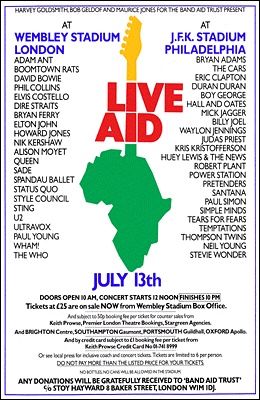
37 years ago this week on July 13 1985; Live Aid, a benefit concert for the people of Ethiopia then suffering through a terrible famine and the largest benefit concert in the world at the time, took place with two simultaneous shows in London and Philadelphia as well as being broadcast worldwide in TV. Smaller concerts were also held in the Soviet Union, Canada, Japan, Yugoslavia, Austria, Australia and West Germany and parts of these shows were also aired.
DIRE STRAITS & STING ~ "MONEY FOR NOTHING";
Best known now (musically at least) for sets by Queen (that kicked off their comeback), a Black Sabbath reunion with Ozzy, a Led Zeppelin reunion (with Phill Collins), a Who reunion, Dire Straits (with Sting) and U2. The sets by U2, Dire Straits and Simple Minds helped make them major stadium stars, although in the case of Simple Minds it would not last. In checking out the line-up I see there were several last minute additions not on the poster including Black Sabbath (with Ozzy), Tom Petty, Madonna, The Hooters, Tina Turner, Paul McCartney, Cliff Richard, Four Tops, RUN DMC, George Thorogood w/Bo Diddly & Albert Collins, BB King (via satellite from Holland) Prince (ditto), Loudness (from Tokyo), Autograph (from Russia), Kool & The Gang (from a studio), Pat Metheny, CSNY, The Beach Boys, Joan Baez, Teddy Pendergrast (in his first appearance aftr being paralyzed in a car accident) and Dylan with Keith Richards & Ron Wood closing the show. Most acts did from one to three songs bout a few got slightly longer sets. Phill Collins actually played both shows as he palyed London then hopped on the Concorde and flew to America to play with Zeppelin. As I recall the set with Dylan, Keith Richard and Ron Wood was a complete trainwreck as was the Zeppelin set as it was obvious none of them had bothered to rehearse.
U2 ~ "SUNDAY BLOODY SUNDAY";
The concert was a by-product of the "Do They Know It's Christmas" single the previous year arranged by Bob Geldoff and Midge Ure and the following singles in America ("We Are The World") and Canada "Tears Are No Enough"). I was too young to have actually seen any of these bands but as a New Wave kid watching on TV I was primarily there for U2, Simple Minds, Pretenders, Ultravox and Adam Ant in that order.
SIMPLE MINDS ~ "DON'T YOU FORGET ABOUT ME";
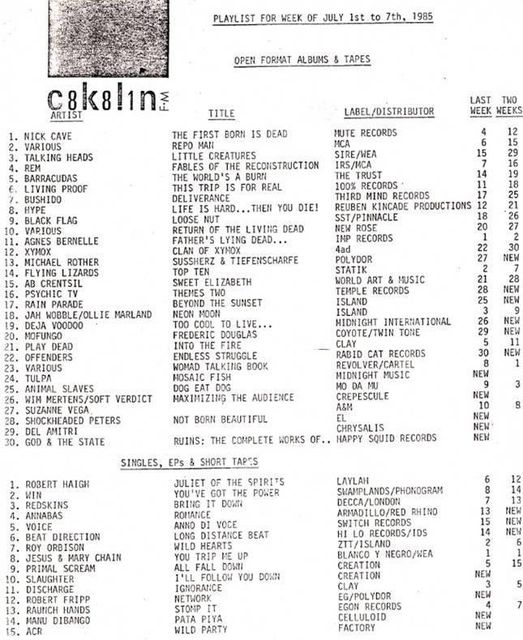
In Toronto one oddity was that the only radio station that simulcast the entire concert was the tiny campus station CKLN (rival CIUT did not go on air until the next year) using their cable feed. CKLN had been on air since 1981 and was by this point known as a station which played underground and avant garde music and most of the bill was totally mainstream but among the New Wave acts who had been on the CKLN/campus charts only a few years earlier; U2, Simple Minds, the Pretenders, Ultravox, the Boomtown Rats, Tom Petty, Elvis Costello, Style Council, Adam Ant, Sting (in the Police), the Cars, Alison Moyet (in Yazoo), Paul Young (in the Q-Tips), Tears For Fears (including as the Graduates), Run DMC and Judas Priest plus Bowie, Bryan Ferry, Paul Simon's "Graceland" & Neil Young's "Trans" albums. Although by 1985 some of these acts certainly still got some airplay on CKLN along with other campus stations that were less aggressively avant garde than CKLN.
THE PRETENDERS ~ "MIDDLE OF THE ROAD";
By contrast here are the actual CKLN Charts for July/85; The Jesus & Mary Chain (and it's early wall-of-feedback era too, Hell Yeah!), Nick Cave, Black Flag, the Barracudas, Deja Voodoo, REM, Talking Heads (their last decent album), Discharge, Robert Fripp, Jah Wobble, Psychic TV, Rain Parade, Primal Scream, A Certain Ratio, Del Amitri, the Redskins (best name for a Marxist Mod band ever), Slaughter (the Toronto Thrash band not the later US Hair Metal band), Living Proof, Suzanne Vega, Roy Orbison's comeback album and the soundtracks for "Repo Man" & "Return Of The Living Dead". About the only bands here that could have possibly been asked to play Live Aid would have been Talking Heads if they had not essentially stopped touring by that point and maybe Robert Fripp with King Crimson who also were not touring. I could possibly see Suzanne Vega doing "Luka" in a studio via satellite. REM had not yet made the jump to stadium status by that point. Mind you it would have been cool if early Jesus & Mary Chain and Deja Voodoo had played. And by cool I mean a glorious clusterfuck of historic proportions. I don't think the TV audience was ready for that.
The recent ruling by the Canadian Broadcast Standards Council (CBSC) banning the 1985 Dire Straits song "Money for nothing" from the airwaves of Canada has brought on reactions ranging from furious to laughingly dismissive. Many however do not really deal with the issue of how to judge the song, any song, in the first place. In the aftermath of the ruling a number of radio stations reacted by immediately and ostentatiously defying the ban by playing the song over and over for a hour, which is all very amusing, but not very enlightening. It misses an opportunity to have a discussion, or even debate about the issue of how to judge a song at all in the context in which it was written.
First a reminder of the lyrics in question from the song "Money for nothing"; "That little faggot with the earing and the makeup, Yeah Buddy, that's his own hair. That little faggot got his own jet airplane. That little faggot, he's a millionaire."
Dire Straits ~ Money for nothing;
A single listener in Newfoundland, who is herself gay, made a complaint to the CBSC who eventually ruled that because of the use of the word "faggot" the song was offensive and could not be played on the air in Canada in that version, however an edited version could be played. In fact it turns out Dire Straits (or their record company) had already anticipated this reaction when the song first came out twenty five years earlier and in fact an edited version had long been made available to radio stations and even the version on the greatest hits album is different from the original and does not contain the offending lyrics. The band had even played the song live with the offending word changed to "That little queenie". Why that would be less offensive I'm sure I don't know. Clearly the song had generated some criticism in the past, those complaints were not in Canada however, and were not made official so all this escaped most public notice till now. The CBSC ruled the song offensive solely due to the use of the word "faggot" and banned it from the airwaves of it's member stations.
A few words here about the CBSC. The Standards Council is not, as many assume, a government regulator unlike the Canadian Radio and Telecommunications Commission (CRTC), though many confuse the two. The CBSC is a body set up by private broadcast networks (both radio and television) to self regulate the industry and respond to listener complaints so the CRTC doesn't have to. Unlike the CRTC, the CBSC has no actual enforcement powers, although in theory a station which racked up a large number of complaints and refused to adhere to industry standards could find itself in front of the CRTC to answer complaints and risk losing their license. I know of only one station that has actually pushed things that far however, and that was Quebec station CHOI in 2004 who did end up losing their license but then the owners sold it anyway while they were appealing the ruling. The only power the CBSC has is to order the offending station to air their ruling as an ad. It should also be pointed out that the CBSC rulings only apply to it's own members, which include all the major networks and stations but which do not include public broadcasters like the CBC and TVO, nor does it apply to campus and community stations. Most religious stations are also not members.
The questions raised by the ruling are many; the CBSC ruled that the word "faggot" was now so offensive that it could not be aired, although they conceded that the song had already been heavily aired for over twenty years and was a huge chart topping hit off one of the biggest selling albums of all time without generating any controversy the whole time. The CBSC decided that now however the word was no longer acceptable. But at what point did this shift happen? And why based on a single complaint? Is that really enough to assume a broadly based public consensus on the issue? Those few who supported the ban would inevitably point to the use of the "n-word" as a comparison. However few would deny that there is, and has been a longstanding consensus around the offensiveness of the "n-word". In contrary to popular belief fact that term has actually been offensive for at least a century. Even a look back at stereotype racist entertainment of decades ago such as "Amos and Andy" and minstrel songs do not show the use of the "N-Word". Outside of a few very rural country records from the 1920's it seems that nobody was prepared to use the word in polite or even semi-respectable society. The use of the "N-word" has always been seen as an especially cruel insult and nothing but and use of it would identify the user as not only a bigot but an uneducated one at that. I see no longstanding consensus here. Instead what we have here is an attempt to enforce such a consensus from above, and given the almost universal outcry it has clearly failed.
The argument has been made that standards change, and that a word that was once considered inoffensive can be considered on longer acceptable years later. The example of the "n-word" may be overblown but there are plenty of other only slightly less racist terms that used to be used on radio and t.v. as late as the 1960's that would not be allowed now. But this process came from below, after a public consensus was formed, it was not enforced from above on the unwilling.
There is another issue as well over the matter of context. Any reading of the song lyrics as a whole make it clear that Dire Straits singer/songwriter Mark Knopfler was using a common device of placing the song in the third person and putting himself in the role of the character narrating the song in that character's point of view. This a songwriting device he has used before and since. There is no question that he is not advocating or presenting his own views. The ground breaking video makes this even more clear.
In his rare interviews Knopfler has said that the song is based on a long rant he overheard at an appliance store in which one of the resentful blue collar workers was complaining about the easy life rock stars have compared to his own. The song also portrays not only the character's bitterness over the easy life of rockstars (like Knopfler) but also his envy;
"Now that ain't working, that's the way you do it Let me tell you them guys ain't dumb Maybe get a blister on your little finger Baby get a blister on your thumb"
and the character makes it clear he would gladly change places;
"I should have learned to play the guitar I should have learned to play them drums Look at that mama, she got it sticking in the camera Man we could have some."
Thus the song shows quite effectively one of the dirty secrets of dead end working class resentments that have been exploited by those with real money and power to keep them distracted and divided. This has been seen in the racism of the Jim Crow era (and beyond) to the the hate campaigns waged against immigrants, "welfare queens" and teachers ever since. And does so in a manner that is so blatant in it's resentment vs. envy juxtaposition that it's actually amusing rather than simply preachy, which is not that easy to do. It's also more effective. Not mention clearly more popular.
Oddly the inconsistent and arbitrary nature of such censorship meant that while the word "faggot" was deemed too offensive to live, other veiled racist insults were not;
"And he's up there, what's that? Hawaiian noises? Banging on the bongos like a chimpanzee"
Anyone with any sense of rock and roll history would recognize that Knopfler was both using and mocking the "rock and roll" is "jungle music" insult that has been aimed at rock by racists since the 1950's here but for some reason this isn't offensive even though it's being said by the same character in the same song.
The issue of context and songwriting reminded me of a controversy over another song of the same era from a very different group, Guns n' Roses and the song "One in a million". This song was never going to be a single and there is no video for it, which is not surprising since it is clearly offensive. The lines that caused immediate controversy were;
"Only some niggers, that's right Get out of my way Don't need to buy any of your gold chains today"
"Immigrants and faggots They make no sense to me Think they come to our country And think they'll do as they please. Like start some kinda mini Iran Or spread some fucking disease. They talk so many God Damn ways it's all Greek to me."
Guns n'Roses ~ One in a million;
There should have no surprise that radio wouldn't touch the song or that protests ensued but oddly enough singer/songwriter Axel Rose seemed genuinely surprised and offended that anyone would question his motives. His reactions in the media ranged from the dismissive "can't everybody take a joke?" to the defensive "you haven't walked in my shoes" variety to a convoluted explanation claiming that he wasn't writing from his own point of view after all. He also pointed to a line further on in the song which he claimed distanced himself from politics at all and was simply displaying another strain of the working class white guy portrayed in the Dire Straits song, or for that matter any number of Merle Haggard songs;
"Radicals and racists? Don't point you finger at me. I'm just a small town white boy trying to make ends meet. Don't need your religion, don't watch that much TV. Just making my living Baby Well that enough for me."
I think there differences here between the Dire Straits and Guns n'Roses songs however;
a) The Dire Straits song is consistent in it's theme; "Money for nothing" establishes it's simple theme from the start and sticks to it throughout. While "One in a million" is all over the map, at times it is a typical heavy metal power ballad love song and the next line it's a racist rant. The two parts seem to have nothing to do with each other.
b) The use of humour and the vocal delivery; Knopfler makes it clear that he is paying a role by adopting a somewhat exaggerated yobbish voice while in character, another device he has used elsewhere, such is in the song "Industrial Disease". The character's often incoherent ranting is so nonsensical and ill informed that there is no doubt that the character is not Knopfler himself, quite apart from the subject matter which makes it unlikely that Knopfler, a famous rock star would be complaining about how he has to install appliances while rock stars like Mark Knopfler get all the chicks on their private jets. Rose on the other hand delivers the lines in his usual singing voice and in fact does so with with such venom that there is no distance and no way it can be seen as a joke. It just plain sounds like something Rose would say. It is hard to see references to "Immigrants" who "talk so many Goddamn ways" and "think they can come to our country and think they'll do as they please" or "faggots" "spreading some fucking disease" as being humorous to anyone who isn't a hateful bigot, they are simply hate filled rants. You will notice that there is in fact some laughter in the above live video when he says the word "faggot", but this seems to be of the "wasn't it cool he said faggot" variety and it is hard not to think that was not his real intent. This at least gives Rose the benefit of the doubt in assuming that he is not really a vile homophobic racist but was merely engaged in adolescent "Hey look how offensive I can be" posing. But after having struck that pose he can't very well be offended that people were offended.
c) Songwriting styles; As stated Mark Knopfler has often used the "third person" device in his songwriting, in fact it is his usual device. When Axel Rose tried to make the same claim however that claim was undermined by his usual insistence that his songs were real and always came from his own hard life experiences (broken home, drugs etc) and were therefore authentic and "real". To make a claim for gritty rock and roll authenticity only to back away and claim "I was only joking this time" is such a transparent attempt to have it both ways that it was dismissed.
Taking all this into account I would have no problem supporting a radio ban on "One in a million", and there was no real controversy about doing so at the time or since, even from those who actually like the song on musical grounds, as do I actually.
Another example from the same era was the comic Andrew Dice Clay who you may recall was very big for a few years with his standup routine in which he posed as a chain smoking Gino and spewed racist, sexist and homophobic insults. This caught on and led to a couple of best selling albums and sell out tours and even a few movies before people got tired of his act. He also got a lot of flack for his rants of course and was also banned from MTV and Letterman. He eventually defended himself by pointing out that he was just playing a character, like Pee Wee Herman, that he was actually a struggling Jewish (not Italian) actor named Andrew Silverstein who had appeared in a Woody Allen movie before stumbling on to the Diceman character. He didn't really mean any of the stuff he said really, it was all just an act. This as no doubt true but he kept up the act for so long as it made money and made no attempt provide any sort of context either in the act or outside of it, he simply insulted and offended entire groups for the amusement for his audience of mostly adolescent males that as he the media tired of his act he would get little sympathy. His career petered out on it's own without any need to ban him.
When the Dire Straits ruling came down an incident occurred which showed the implication of using censorship to bring about social change. CBC did a feature (I think hosted by Evan Soloman) to discuss the issue. It the interest of balance he had to find someone who actually supported censorship. After no doubt much searching he managed to find a pro-censorship voice in the person of...wait for it..."Now Magazine" editor Susan G Cole. Excuse me the editor of the nation's largest "progressive arts and entertainment weekly" is suddenly in favour of censorship? WTF? Hasn't "Now" always prided itself on been in the forefront against censorship? Think the "Little Sisters Bookstore" case. Think their support of the "Anti-Isreali Apartheid" movement and campus freedom of speech. Think about the classified sex ads and sex advice columns in now itself. Well it turns out that this is totally different because Susan G. Cole was offended over the use of the word "faggot" so naturally it has to be banned. That seems totally fair and not even a little hypocritical. Naturally I expect that "Now" will now ban all the sex ads they make their living from since these clearly offend far more people than Dire Straits does. And the same for the use of the word "apartheid" which deeply offends many people. No? Hmmm.
Cole also had a another argument to back that up of course. When the other guest (whose name I can't recall) pointed out the rather obvious fact that the intent and context of the song were not in fact homophobic or racist nor were any of Knopfler's other songs, Cole conceded the point but then actually went on the say that of course she was capable of getting the song's context but most Rock and Roll fans were not capable of such nuance. Gee thanks Susan, glad we have you here to do our thinking for us. As insulting as Cole's almost ludicrous impression of every patronizing "elitist liberal" that right wingers rail against, she accidentally illustrates a point here. Censorship from above, no matter how noble the stated aims, is always elitist and hypocritical.
---------------------------------------------------------------------- Dire Straits "Money For Nothing" lyrics;
"I want my, I want my M.T.V.
Now look at them yo-yo's, that's the way you do it You play the guitar on the M.T.V. That ain't working, that's the way you do it Money for nothing and your chicks for free
Now that ain't working, that's the way you do it Let me tell you them guys ain't dumb Maybe get a blister on your little finger Baby get a blister on your thumb (chorus) We got to install microwave ovens Custom kitchen deliveries We got to move these refrigerators We got to move these colour T.V.'s
The little faggot with the earring and the makeup Yeah buddy, that's his own hair That little faggot got his own jet airplane That little faggot he's a millionaire
(chorus)
Look at that, look at that I should have learned to play the guitar I should have learned to play them drums Look at that mama, she got it sticking in the camera Man we can have some And he's up there, what's that? Hawaiian noises? Banging on the bongos like a chimpanzee Oh, that ain't working, that's the way you do it Get your money for nothing get your chicks for free
(chorus)
Listen here Now that ain't working, that's the way you do it You play the guitar on the M.T.V. That ain't working, that's the way you do it Money for nothing and your chicks for free Money for nothing and chicks for free
Get your money for nothing, get your chicks for free Money for nothing, chicks for free Look at that, look at that Get your money for nothing, get your chicks for free (I want my, I want my, I want my M.T.V.) Money for nothing and chicks for free Easy, easy
That ain't working
---------------------------------------------------------------------- Guns n' Roses "One in a million" lyrics;
"Guess I needed sometime to get away I needed some piece of mind Some piece of mind that'll stay So I thumbed it down to Sixth and L.A. Maybe a Greyhound could be my way
Police and Niggers, that's right Get out of my way Don't need to buy none of your Gold chains today I don't need no bracelets Clamped in front of my back Just need my ticket; 'til then Won't you cut me some slack? (chorus) You're one in a million Yeah, that's what you are You're one in a million, babe You're a shooting star Maybe someday we'll see you Before you make us cry You know we tried to reach you But you were much too high.
Immigrants and faggots They make no sense to me They come to our country And think they'll do as they please Like start some mini Iran, Or spread some fuckin' disease They talk so many goddamn ways It's all Greek to me
Well some say I'm lazy And others say that's just me Some say I'm crazy I guess I'll always be But it's been such a long time Since I knew right from wrong It's all the means to an end, I I keep it movin' along
(chorus)
Radicals and Racists Don't point your finger at me I'm a small town white boy Just tryin' to make ends meet Don't need your religion Don't watch that much T.V. Just makin' my livin', baby Well that's enough for me
When I used to live down on Gerrard Street I used to often pass by a building on 225 Mutual Street called the Mutual Street Studios and wondered what it was. It was a single story building with a front done in that vaguely art-deco style of the 1950's and 60's with a wide foyer and jutting veranda. It's retro-gone-somewhat-to-seed look stood out. It looked like how you would expect Sun, Chess or Stax studios to look. I always wondered what it looked like inside. I couldn't tell if it was still being used as either a recording or television studio anymore. Sometime last year or so it became obvious that it was sitting empty. Now it's gone, demolished as of September. It wasn't until it was gone that I found out about it's storied history and roll in Toronto's musical history. It turns out that CHUM radio got it's start there in 1947 before they moved to their 1331 Younge street headquarters. Then RCA Records took it over and used it as a recording studios recordings the likes of Rosemary Clooney and Mel Torme to rock legends like Aretha Franklin, Wilson Pickett, James Brown, Gordon Lightfoot, Steve Winwood, Rush, B.T.O., Mark Knopfler, BB King and Anne Murray. Mutual Street Studios was in fact the last of the studios in Toronto that was large enough to handle full scale orchestras and was known for it's great acoustics. Unfortunately there was less and less call for studios as the years went on due to changing tastes (less strings and horns) and cheaper smaller studio setups and RCA sold the building in 1970 to McClear Studios who kept it running for film post production and soundtrack recording until they went bankrupt in 2005 and the building sat empty until the neighboring Best Western Hotel bought it. This September they demolished it to make room for more parking. Bastards. This is actually not the first time this has happened on Mutual street which must have been a fairly important street once upon a time. Believe it or not two blocks further south sat the Mutual Street Arena, home of the Toronto St. Pats, the NHL hockey team in the 1920's before Conn Smythe renamed them the Maple Leafs and built Maple leaf Gardens which has itself been dodging the wrecking ball for years now. Mutual Street Arena manged to stick around for decades as The Palace, a roller rink until the early 1990's when it was demolished to make room for condos and a Dominion store. The same fate some had planned for the Gardens as well. I swear Totonto has no knowledge or respect for it's history. For more details on Mutual Street Studios check out The Torontoist. Click on the title of this article for a direct link.